Doubts about God and the Gospels
What you may have heard
Who created God?
If everything needs a cause, then God needs one too. And if God can exist without a cause, so can the universe, which means adding God explains nothing.
What the evidence shows
You are right that “everything has a cause, so God made the universe” would be a bad argument, because it would apply to God as well. The careful versions never say that. They say that things which begin to exist, or which could have failed to exist, need an explanation, and that the explanation has to end in something that did neither. Whether that something is God or the universe itself is the real question, and this page argues that the universe is the weaker candidate.
On this page
- Why it seems true
- The careful arguments never say that everything has a cause
- Everyone has to stop somewhere, and the question is where
- The universe looks like a poor place to stop
- A necessary being is not one more thing with an exemption
- This argument reaches a necessary cause, not the Christian God
- Questions you might still have
- Where this leaves us
- Check the sources
Why it seems true
The question feels decisive because it turns the argument against itself. Children ask it, and so have serious philosophers. Bertrand Russell said he gave up the first-cause argument at eighteen, after reading John Stuart Mill point out that “Who made me?” leads straight to “Who made God?” If every thing needs a cause, God does too. If God is allowed to be the exception, the exception looks invented to rescue the conclusion. And if we may stop somewhere with something that has no cause, why not stop at the universe, which at least we know exists? Adding God seems to add a mystery rather than remove one.
Much of this is right. If an argument began “everything has a cause,” your question would sink it, and popular presentations do sometimes talk that way, so you may well have met that version. Special pleading, carving out an exception with no reason except that you need one, is a real fallacy. And you are right that every explanation stops somewhere. The atheist and the theist both end with something that is not explained by anything further. The disagreement is about where to stop, and that is a fair question to argue about.
The careful arguments never say that everything has a cause
Arguments that reason from the existence of the world to a first cause are called cosmological arguments. The Stanford Encyclopedia of Philosophy surveys the main forms, and none of the serious ones starts from “everything has a cause.” Their premises are deliberately narrower.
- The argument from contingency. A thing is contingent if it exists but could have failed to exist. You, the earth, and the Milky Way are all contingent. The argument says contingent things need an explanation outside themselves for why they exist rather than not.
- The kalam argument. First developed by medieval Muslim philosophers and defended today by the Christian philosopher William Lane Craig, it says that whatever begins to exist has a cause.
Each premise covers only things that could have failed to exist, or things that began. The conclusion each argument draws is that there must be something that is neither: something that exists without depending on anything else, and that never began. Classical theism, the view of God held by Jewish, Christian, and Muslim philosophers for centuries, describes God in exactly those terms. So the premise does not reach God, and that was the argument’s point from the start, not a loophole added afterward.
Everyone has to stop somewhere, and the question is where
Take any explanation and keep asking “and what explains that?” You end up with one of three things.
- An endless chain. Each dependent thing is explained by an earlier dependent thing, forever.
- A brute fact. At some point the answer is “it is there, and that is all.” Russell took roughly this view of the universe in a well-known 1948 radio debate.
- Something that exists by its own nature. Philosophers call this a necessary being: one that depends on nothing else and could not have failed to exist.
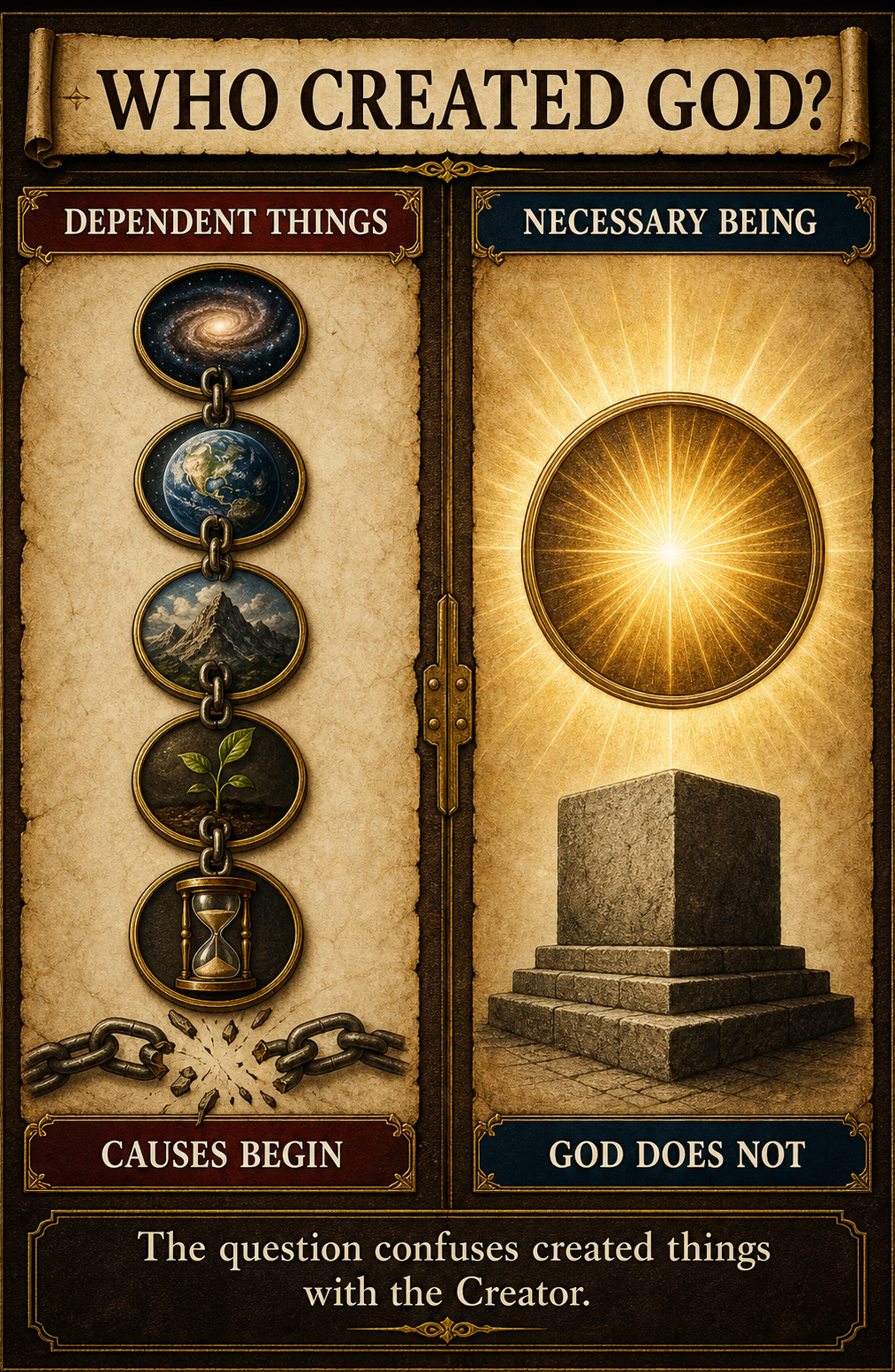
An endless chain of dependent things still leaves the whole chain unexplained. A train of carriages, each pulled by the one in front, never tells you why the train is moving, however many carriages you add. So the choice is usually between the second and third options. Your question assumes the theist is breaking a rule by stopping at God. Both of you stop. The question is which stopping point explains better.
Two places to stop
Both views end with something that is not explained by anything further. The question is which kind of thing can bear that weight.
Stop at the universe
The universe, or its earliest state, exists with no explanation beyond itself. It is the brute fact.
The question it raises
Can something made of parts that could each have been otherwise be the thing that needed no explanation?
Stop at a necessary being
Something exists that depends on nothing and could not have failed to exist, and everything else depends on it.
The question it raises
Is there good reason to think such a being exists, and what would it have to be like?
“Who created God?” assumes only one side has to stop. Both do, so the argument turns on which stopping point is the better explanation.
The universe looks like a poor place to stop
Everything we observe in the universe is contingent. Stars form and burn out. Particles decay. The physical constants have particular values that physicists can describe but, so far, cannot derive from anything deeper. Every part of the universe looks like something that could have been different, or could have been absent.
Russell had a sharp reply to this: every human has a mother, but the human race does not have a mother, so you cannot infer a property of the whole from its parts. That is a fair warning, and it sometimes applies. Sometimes it does not: a wall built entirely of red bricks is red. A universe made entirely of things that could have failed to exist looks more like the wall than like the human race. Nothing about it suggests it had to exist.
Cosmology adds a further consideration, to be held more loosely. The standard Big Bang model traces the observable universe back to an extremely hot, dense state about 13.8 billion years ago. Some physicists think that was an absolute beginning; others propose models in which something came before it. This page does not depend on settling that. Even an endlessly old universe would still be a collection of contingent things.
A necessary being is not one more thing with an exemption
Special pleading means treating two cases differently with no relevant difference between them. Here there is a relevant difference. The universe is the kind of thing the premise is about: dependent, changing, and possibly begun. A necessary being, by definition, is not. Treating different kinds of things differently is not special pleading when the difference is the very one at issue.
It helps to see what Christians mean by God. “Who created God?” pictures him as a very large object at the front of the line, the first domino, and that is not the claim. The Bible opens with “In the beginning God created the heavens and the earth” (Genesis 1:1), but Christians hold that God is more than the one who started things. He is the reason there are any dominoes at all, and he keeps everything in existence at every moment. A New Testament letter says of Christ that “in Him all things hold together” (Colossians 1:17). Paul, in a speech recorded in the book of Acts, told an audience in Athens that God “gives everyone life and breath and everything else,” and that “in Him we live and move and have our being” (Acts 17:25, 28).
The medieval philosopher Thomas Aquinas could argue for a first cause while granting that philosophy alone could not prove the universe had a beginning. His question was what everything depends on now, not what happened first.
This argument reaches a necessary cause, not the Christian God
If the argument works, it shows that something exists necessarily and that everything else depends on it. It does not show, by itself, that this something is personal, good, or the God of the Bible.
Some atheist philosophers accept that something necessary exists and argue that it is the universe’s earliest state, or the laws of physics, rather than God. That is a serious position, and the debate between it and theism is still live. If you hold it, you have already given up the idea that “Who created God?” ends the conversation; you are arguing about which necessary thing is more plausible.
Christians believe more than this argument can deliver, and they believe it on other grounds: that the moral law we feel binding on us points to a good source, which is the moral argument, and above all that God made himself known in Jesus of Nazareth. Those are separate arguments, with their own evidence.
A contingent being (a being such that if it exists, it could have not-existed) exists.
Everything that begins to exist has a cause of its existence.
At a glance
Dependent things and a necessary beingThe contrast the argument draws: a chain of things that each depend on something else, and a necessary being that does not.Show the chart
Questions you might still have
Isn't calling God "necessary" a way of defining him into existence?
No. The cosmological arguments do not start from a definition of God. They start from things you can observe, such as the existence of contingent things, and reason toward what would have to be true to explain them. “Necessary being” names the conclusion; it is not slipped into the premises. You can reject a premise, and many philosophers do. There is a different argument, the ontological argument, that tries to show God exists from the concept of God alone, and plenty of theists reject that one too. This page does not rely on it.
Couldn't the universe itself be the necessary thing?
In principle, yes, and some philosophers hold that view. It needs to be argued for, though, not assumed in order to avoid God. The difficulty is that everything we observe in the universe changes and could have been otherwise, and its constants and laws look like particular settings rather than things that had to be. A necessary thing would be one whose nonexistence was impossible. It is hard to see why that would be true of this particular arrangement of matter and energy. The question is open.
Isn't "God did it" a way to stop asking scientific questions?
It would be if it replaced scientific explanation, and you are right to be wary of arguments that put God wherever science has not yet reached. This argument works at a different level. Science explains one thing in the universe by another: this state by an earlier state, this particle by a field. The question here is why there is a universe of dependent things at all. Science by its method does not ask that, and a scientist can pursue every physical question with full energy whatever the answer is.
Even if something necessary exists, why think it is a person?
This is the weakest link for anyone moving from this argument to Christianity, and it is fair to press it. Some philosophers argue that a cause existing outside time, which brought about a universe that did not have to exist, must have something like a will, because nothing about a timeless, unchanging set of conditions explains why it produced this rather than nothing. Many readers will find that step less secure than the rest. Christians do not rest their belief in a personal God on this argument alone. They rest it mainly on the claim that God showed himself in a person, Jesus.
Where this leaves us
“Who created God?” is a sharp question to put to the claim that everything needs a cause. That is not the claim the careful arguments make. They hold that dependent and beginning things need an explanation, and that explanation has to end in something that is neither. Both you and the theist stop at something unexplained; the question is whether the universe or a necessary being is the better place to stop. Even if the argument succeeds, it does not tell you who or what that being is. That is the next honest question, and Christians answer it by pointing to a particular person in history.
Keep reading
- Contingency and creationScience explains one state of the world by an earlier one. It cannot say why there is anything to study, and a self-existent ground answers that better than a brute fact.
- Fine-tuning and ordered creationThe weak popular examples fall away. What remains is the constants and starting conditions of physics, and design is one explanation worth weighing.
- Objective morality and GodThis argument does not claim you need God to be good. It asks what makes moral obligation binding and human worth real, and argues that God is the best explanation.
- Science has disproved ChristianityScience has changed how Christians read some texts, but its methods cannot show that nature is all there is. Christianity's central claim is historical.
- God is hiddenThe hiddenness argument assumes love must guarantee belief now. Christianity questions that premise and points to Jesus as God's public answer.
- Miracles are impossibleNatural laws describe what nature does when left to itself. They cannot rule out a God who acts, so the real question about miracles is the evidence.
Check the sources
This page relies on these sources. Each has its own page with the full citation and, where one exists, a link to the original.
- Reference workCosmological Argument
- ScholarshipThe Kalam Cosmological Argument
- Primary sourceWhy I Am Not a Christian
- Primary sourceA Debate on the Existence of God