What you may have heard
The Bible is corrupted
I believe the Bible Christians read today is not the Injil God gave to Jesus. It was changed over the centuries; even Christian scholars admit the manuscripts disagree and the originals are lost.
What the evidence shows
You are right that the New Testament manuscripts differ in many small ways, that a few passages were added later, and that no original copy survives; Christian scholars say all of this openly. Differences in wording are not the same as a lost message. The sheer number of manuscripts is what lets scholars recover the text, and the crucifixion and the claims about Jesus that the Qur’an disputes do not depend on any doubtful verse. The Qur’an itself tells the Christians of Muhammad’s day to judge by the Gospel they had, and we can still read that Gospel.
On this page
- Why it seems true
- There are two kinds of tahrif, and they need different evidence
- The Qur'an speaks to Christians as people who have the Gospel
- The Gospel Christians held in Muhammad's day still exists
- Variants are real, and they are how the text is recovered
- The same standard should apply to the Qur'an's history
- A lost Injil would have left a trace
- Questions you might still have
- Where this leaves us
- Check the sources
Why it seems true
The Qur’an honors the Torah and the Injil (the Gospel) as books God sent down, with guidance and light in them. Yet the Bible Christians read today says that Jesus was crucified and that he is the Son of God, and the Qur’an denies both. If God’s earlier books and his final book cannot disagree, something must have happened to the earlier ones. The Qur’an itself speaks of people who “distort words from their [proper] places” (4:46) and who “write the ‘scripture’ with their own hands” (2:79). The charge of tahrif, the Arabic word for this distortion, seems to follow.
Modern scholarship appears to confirm it. Bart Ehrman, a well-known New Testament scholar, points out that there are more differences among the manuscripts than there are words in the New Testament, that no two manuscripts agree exactly, and that copyists sometimes changed the text on purpose. The original documents are lost. And where the Qur’an speaks of one Injil given to Jesus, Christians have four Gospels written by others after him.
Much of this is accurate. There are hundreds of thousands of differences between the surviving manuscripts. A few well-known passages are almost certainly later additions: the story of the woman caught in adultery (John 7:53-8:11), the longer ending of Mark (16:9-20), and a line about the Father, Word, and Spirit in 1 John 5:7. Ordinary Christian Bibles mark them in brackets or footnotes. No original copy of any New Testament book survives. Ehrman’s figures are real, and he is a serious scholar. And the Qur’an does accuse some among the People of the Book of twisting Scripture. Whether any of this amounts to the loss of the Gospel is a separate matter.
There are two kinds of tahrif, and they need different evidence
Muslim scholars have long distinguished two charges. Tahrif al-ma’na is distortion of meaning: the words are intact, but people misread or misapply them. Tahrif al-nass is distortion of the text itself: the words were altered or replaced. They have argued for centuries about which the Qur’an means. The Andalusian scholar Ibn Hazm, writing in the eleventh century in his al-Fisal, pressed the strong textual version. Many others held the softer one.
Read the verses closely and you will see why the question stayed open. Qur’an 3:78 speaks of “a party who alter the Scripture with their tongues so you may think it is from the Scripture.” 4:46 speaks of Jews in Medina who “distort words from their [proper] places,” and gives examples of spoken words. 2:75 speaks of some who heard God’s words “and then distort it.” These describe what particular people did with Scripture, in speech and interpretation. None of them says that the Gospel held by Christians everywhere had been replaced.
This page asks about the stronger charge, because that is the one that would mean the Bible Christians read is not the Gospel at all.
The Qur'an speaks to Christians as people who have the Gospel
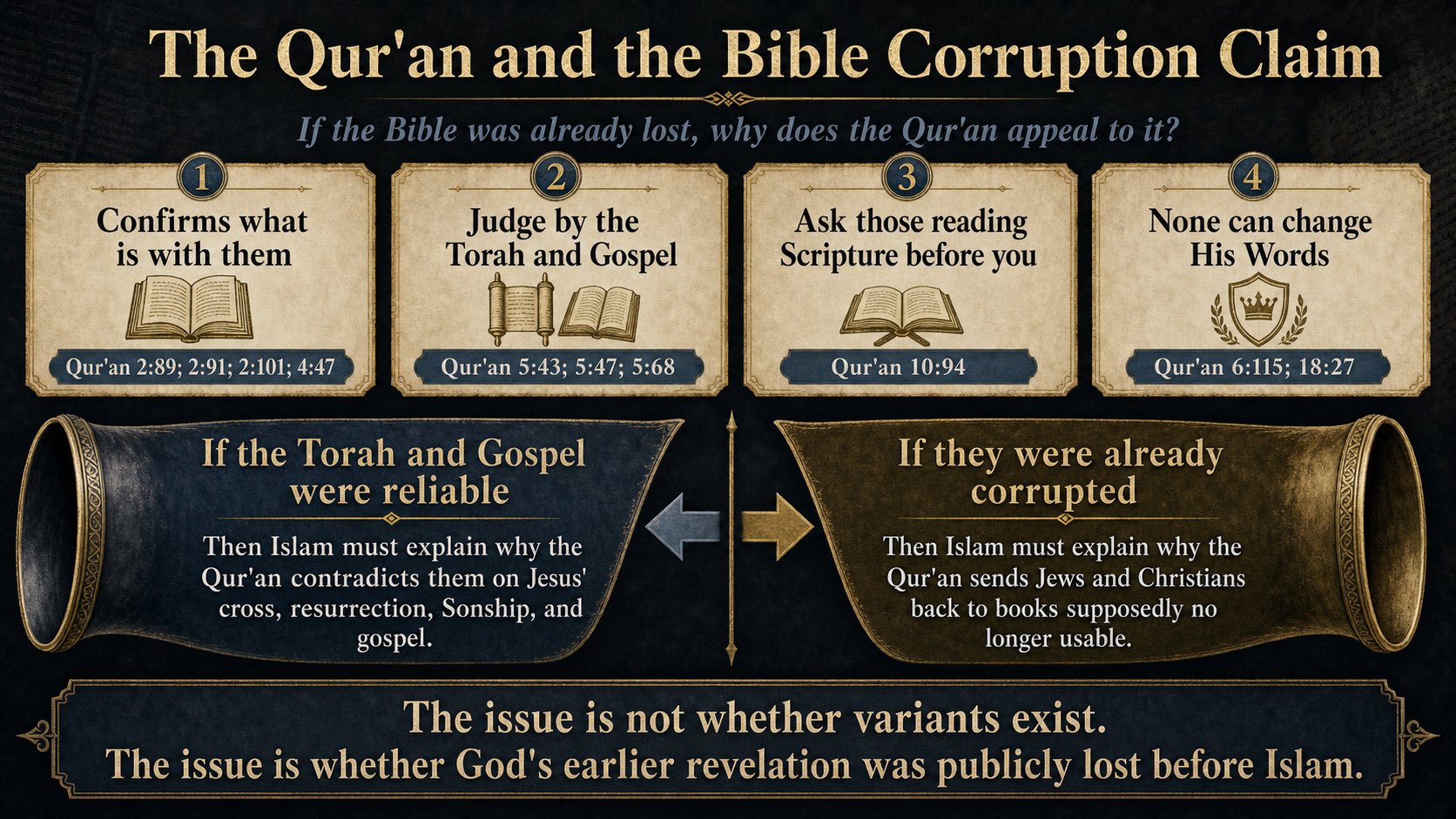
The Qur’an does not tell the Christians and Jews of Muhammad’s own time that their books are gone. It tells them to use them.
- “Let the People of the Gospel judge by what Allāh has revealed therein” (5:47).
- Of the Jews: “they have the Torah, in which is the judgement of Allāh” (5:43).
- “O People of the Scripture, you are [standing] on nothing until you uphold [the law of] the Torah, the Gospel, and what has been revealed to you from your Lord” (5:68).
- “If you are in doubt… then ask those who have been reading the Scripture before you” (10:94).
- It describes the Prophet as one “whom they find written in what they have of the Torah and the Gospel” (7:157), and itself as “confirming that which is with you” (4:47).
The Qur’an also says, “None can alter His words” (6:115).
Some commentators read 5:47 as addressed to Christians of Jesus’ own time. Even on that reading, 5:43, 5:68, 7:157, and 10:94 speak in the present tense to people in Muhammad’s day, about what they have and read.
These verses assume that seventh-century Christians held a Gospel they could read, judge by, and be held to. If that Gospel was already corrupted beyond use, the command in 5:47 would ask them to judge by a book that could no longer guide them. If it was usable, then the next question is what that Gospel said.
The Gospel Christians held in Muhammad's day still exists
This part of the question can be checked. Muhammad received the Qur’an between about 610 and 632. Long before that, Christians had large copies of the Greek Bible. Two of the best known, Codex Sinaiticus and Codex Vaticanus, were copied in the fourth century, about two and a half centuries before the Qur’an. Sinaiticus contains the whole New Testament, and both contain all four Gospels. By then the Gospels had also been translated into Latin, Syriac, and Coptic, and were read by churches from Spain to Persia and beyond, most of which had no contact with each other.
Scholars have catalogued thousands of Greek manuscripts, and many of them come from before the seventh century or from the centuries around it (how the count is made). In every one of these traditions, the Gospel is the same four books: Matthew, Mark, Luke, and John. In every one, Jesus is crucified under Pontius Pilate and his followers proclaim him raised.
So even if you suspect that something changed in the first centuries, the Gospel the Qur’an addressed is not lost. It is the Gospel in these manuscripts, and it teaches the crucifixion the Qur’an denies. Any change that removed an earlier Injil would have to have happened before the Qur’an spoke, in every language and region at once, and without leaving a trace.
What existed before the Qur'an
Approximate dates. The Gospel was copied and translated across many regions well before the seventh century.
About AD 30 to 33
Jesus' ministry ends in Jerusalem
Roman and Jewish writers, as well as his followers, record his execution under Pontius Pilate.
About AD 50 to 100
Paul's letters and the four Gospels
Written in Greek, the common written language of the eastern Mediterranean.
Second to fourth centuries
Translations spread
The Gospels are read in Latin, Syriac, and Coptic, by churches that did not share one government or one language.
Fourth century
Complete Greek Bibles
Codex Sinaiticus contains the whole New Testament, and Codex Vaticanus contains all four Gospels.
About AD 610 to 632
The Qur'an is revealed
It tells the People of the Gospel to judge by what God revealed in it.
A replaced Injil would have to be swapped out across every region and language before the seventh century, without leaving any manuscript or record of the change.
Variants are real, and they are how the text is recovered
Ehrman’s figure is accurate: there are more differences among the manuscripts than words in the New Testament. The reason is the number of manuscripts. Every time a scribe copied a page, small slips crept in, and every surviving copy is counted. Most of these differences are spelling, word order, or an obvious mistake that makes no difference to meaning (what a variant is).
That abundance is also what lets scholars find the original wording. When thousands of copies made in different places are compared, an error made in one place stands out against the rest. That is how scholars identified the late passages, and it is why ordinary Bibles print them in brackets.
Ehrman co-wrote the standard textbook on this subject with Bruce Metzger, The Text of the New Testament. Metzger concluded that the New Testament text can be recovered with very high confidence. Ehrman, who is not a Christian, has said that his own findings do not contradict Metzger’s view that the essential Christian beliefs are not affected by the variants. The crucifixion, for example, is not in a disputed verse. It is in all four Gospels, in Paul’s letters, and in every manuscript tradition.
The same standard should apply to the Qur'an's history
The Qur’an is not on trial here. The aim is one standard for both books.
Sahih al-Bukhari records that after many reciters were killed at the battle of Yamama, Abu Bakr asked Zayd ibn Thabit to collect the Qur’an, and Zayd gathered it from what was written on palm stalks and thin white stones, and from the men who knew it by heart (Bukhari 4986). Later, Uthman had copies made and sent to the provinces, and “ordered that all the other Qur’anic materials, whether written in fragmentary manuscripts or whole copies, be burnt” (Bukhari 4987). Muslim scholars, such as the writers of the Yaqeen Institute’s account, explain this as careful preservation, and that is a reasonable case.
Islamic scholarship also recognizes several canonical readings of the Qur’an, the qira’at. Most differences are matters of pronunciation, but some change the sense enough that an English translation has to mark them, as the Bridges translation of the ten qira’at does.
None of this shows the Qur’an was lost. Collection by people, copying, and variant readings do not by themselves prove a scripture lost, and what does not count against the Qur’an cannot count against the Gospel either.
A lost Injil would have left a trace
If the real Injil was a different book that the four Gospels replaced, then someone replaced it, somewhere, at some time. So far, no one has found evidence of who, where, or when.
No manuscript of an earlier Injil that teaches what the Qur’an teaches about Jesus has ever been found, in any language. No ancient writer, Christian or not, records such a book being suppressed. The churches that disagreed with each other bitterly over many questions all kept the same four Gospels. And the earliest summary of Christian belief, which Paul quotes in a letter from the AD 50s and which scholars date to within a few years of Jesus’ death, already says that he “died for our sins,” “was buried,” and “was raised on the third day” (1 Corinthians 15:3-8).
This does not show that the Gospel is true. It shows that the Gospel Christians have today is the one they had when the Qur’an spoke to them, and the one they had generations before that.
And let the People of the Gospel judge by what Allāh has revealed therein.
So if you are in doubt, [O Muḥammad], about that which We have revealed to you, then ask those who have been reading the Scripture before you.
At a glance
The Qur'an and the claim that the Bible was corruptedFour ways the Qur'an refers to the Torah and Gospel of its own day, and the two possibilities they leave open.Show the chart
Questions you might still have
Doesn't the Qur'an confirm only the original Torah and Gospel, not the Bible Christians have now?
That is the most common answer. The trouble is that the Qur’an does not speak only of a Gospel given long ago. It speaks to Christians in Muhammad’s day about what is “with” them, and tells them to judge by it (5:47). A command to judge by a book assumes the book is there to be read. If the original was already gone, the command could not be obeyed. If it was there, it is the Gospel found in the manuscripts from before and around Muhammad’s time, which are the Gospels Christians read now.
The Qur'an speaks of one Injil. Why do Christians have four Gospels?
A single name can cover a collection. The Torah is one name for what Jews have always read as the five books of Moses. Early Christians spoke of “the gospel” in the singular too, meaning the one message about Jesus, and called the four books the gospel “according to” Matthew, Mark, Luke, and John. The singular word does not tell you there was once a different book. That would need a manuscript, a quotation, or some historical record, and none has been found.
Could the true Injil be the Gospel of Barnabas, or the Gospel of Thomas?
Each needs evidence before it can fill that role. The Gospel of Barnabas, which agrees with Islam on several points, survives only in manuscripts written well over a thousand years after Jesus and centuries after the Qur’an. The Gospel of Thomas is a collection of sayings from a different stream of early Christianity, and it disagrees with the Qur’an as well as with the New Testament on many points. “Q,” which you may also hear of, is a modern scholarly theory about a source behind Matthew and Luke, not a book anyone has.
Catholic and Protestant Bibles have different books. Doesn't that show the Bible is unsettled?
The difference is real, and it concerns a group of Jewish writings attached to the Old Testament, such as Tobit and the books of Maccabees. Christians have disagreed about whether to count them as Scripture. The New Testament is the same twenty-seven books in nearly all Christian traditions, and the disputed Old Testament books say nothing about Jesus’ death or identity. A question about which books belong is a different question from whether the text of the Gospels was replaced.
Does this prove the Bible is God's word?
No. The Gospels Christians read today are, with a few marked exceptions, what Christians were reading long before the Qur’an, and their message about Jesus has not changed. Whether that message is true is a separate question. You can accept everything on this page and still believe the Gospel writers were mistaken. What you can no longer say, on the evidence, is that the Gospel was lost and replaced with something else.
Where this leaves us
The view that the Bible is corrupted starts from real facts: the manuscripts differ, a few passages are late additions, and no originals survive. It does not follow that the Gospel was lost. The variants are how the text is recovered, the Gospel of Muhammad’s day still exists in manuscripts older than the Qur’an, and the Qur’an itself told Christians to judge by it. None of that shows the Gospel’s account of Jesus is true. If this is the Gospel Christians have always had, the question left is what it says about Jesus, and why.
Keep reading
- The reliability of the New TestamentPaul's letters preserve a summary of belief from within a few years of Jesus' death, the Gospels were written within living memory, and the text can be recovered with confidence.
- The apostolic gospel is finalPaul and Jude describe the apostles' message as a trust to guard. So any later revelation can be tested by one question: does it preach the same gospel?
- Jesus was not crucifiedJesus' crucifixion is recorded within years by his followers and later by hostile Roman and Jewish writers; no historical record before the Qur'an says otherwise.
- Muhammad was foretold in the BibleRead in context, Moses' promised prophet comes from Israel, and the Advocate Jesus promised is the Holy Spirit, sent to his own disciples soon after Jesus left them.
- Constantine changed the BibleThe four Gospels were received long before Constantine, and the records of Nicaea show no vote on the Bible's contents and no removal of books.
Check the sources
This page relies on these sources. Each has its own page with the full citation and, where one exists, a link to the original.
- Official sourceThe Qur'an
- Primary sourceal-Fisal
- Primary sourceSahih al-Bukhari
- Representative sourceThe Uthmanic Codex
- Representative sourceBridges' Translation of the Ten Qira'at
- ScholarshipThe Transmission of the Variant Readings of the Qur'an
- Reference workManuscripts 101: What Is a Textual Variant?
- Reference workHow Many Greek New Testament Manuscripts Are There Really?
- Reference workThe Text of the New Testament
- ScholarshipMisquoting Jesus
- Reference workGospel of Barnabas
- Primary sourceCodex Sinaiticus
- Primary sourceCodex Vaticanus (Vat. gr. 1209)