Doubts about God and the Gospels
What you may have heard
Jesus never existed
I don't think Jesus was a real person. There's no evidence from his own lifetime, the stories about him read like myth, and the church could have built him out of older religious ideas.
What the evidence shows
Nearly every historian who studies the ancient world, including agnostic and atheist scholars, concludes that Jesus of Nazareth was a real Jewish teacher executed under the Roman governor Pontius Pilate around AD 30. The evidence is Paul’s letters, written within about twenty-five years by a man who met Jesus’ brother, and Roman and Jewish writers who had no interest in promoting Christianity. That conclusion does not show that anything Christians believe about Jesus is true. It means the open question is who he was, not whether he lived.
On this page
- Why it seems true
- Whether Jesus existed and whether Christianity is true are two separate questions
- Historians who reject Christianity still conclude that Jesus lived
- The earliest writer on Jesus met his brother
- Roman and Jewish writers who disliked Christianity mention him
- A crucified Messiah is not something a new movement would invent
- The pagan parallels are looser than they sound
- Questions you might still have
- Where this leaves us
- Check the sources
Why it seems true
If you look for evidence of Jesus the way you would look for evidence of a modern person, you come up nearly empty. There is no birth record, no Roman trial transcript, no inscription, and nothing Jesus wrote himself. The detailed accounts of his life are the Gospels, written decades later by people who worshiped him, and they are full of miracles. The outside references are few: a paragraph in Josephus that later Christians edited, and a short passage in Tacitus written more than eighty years after the events. Add the claim, common in online videos and some popular books, that virgin births and dying-and-rising saviors appear in older religions, and a mythical Jesus can look like the simplest explanation.
You are right that no document from Jesus’ own lifetime mentions him. The Gospels were written by people who believed in him and wanted others to believe, and that is a real reason to read them carefully. The Josephus passage was altered by Christian copyists, and scholars of every persuasion say so. You are also right to ask why someone this important left so small a mark in Roman records. Followed through, those instincts lead somewhere other than the conclusion that he never lived.
Whether Jesus existed and whether Christianity is true are two separate questions
Showing that a man named Jesus lived in first-century Galilee would not make you a Christian, and it should not. Plenty of real people were believed by their followers to be more than they were. Christians claim far more than his existence: that Jesus rose from the dead, and that he was God’s own Son. Those claims need their own evidence, and nothing on this page supplies it.
This page is about the smaller question. Was there a real Jewish teacher named Jesus, from Nazareth, who gathered followers and was executed by the Romans? You can answer yes to that and remain an atheist; many historians do. Keeping the two questions apart is fairer to you, because it means you can weigh the historical evidence without feeling that agreeing with it commits you to anything more.
Historians who reject Christianity still conclude that Jesus lived
The view that Jesus never existed, usually called mythicism, is held by very few people who teach ancient history or New Testament studies at universities. The scholars who reject it include agnostics, atheists, and Jewish historians, alongside Christians, so the line does not fall between believers and skeptics.
The best-known example is Bart Ehrman, a New Testament scholar who left the Christian faith and describes himself as an agnostic. He has written several popular books arguing that the Bible contains legendary material and that copyists changed its text. In 2012 he wrote a whole book on this question, Did Jesus Exist?, aimed partly at readers who suspect the answer is no. His conclusion, reached on historical grounds alone, is that Jesus certainly existed and was crucified under Pontius Pilate. Ehrman has no reason to make Christianity look good. His skepticism is about what Jesus did and who he was, not about whether he lived.
A consensus is not proof, and you are entitled to check the reasoning yourself.
The earliest writer on Jesus met his brother
Paul is the earliest author whose writing about Jesus survives. He was not a follower during Jesus’ life; by his own account he persecuted the movement before joining it. You do not have to accept anything he says about God to use his letters the way historians use any ancient letter: as evidence of what was being said, and by whom, in the first decades.
In his letter to the Galatians, usually dated between AD 48 and 55, Paul says that three years after joining the movement he went to Jerusalem, stayed fifteen days with Peter, and saw none of the other apostles “except James, the Lord’s brother” (Galatians 1:18-19). Paul was in a position to know whether Jesus had been a real man. He spent two weeks with one of Jesus’ closest companions and met his brother. A heavenly figure invented from myth does not have a brother you can visit in Jerusalem.
Paul also hands on a short summary of the faith that he says he had himself received (1 Corinthians 15:3-8). Scholars widely date it to within a few years of the crucifixion. It names people, including Peter and James, who were alive and known when Paul wrote.
How close the earliest evidence is
Approximate dates as most historians give them. The earliest evidence comes from people who knew Jesus’ family and companions.
About AD 30 to 33
Jesus is executed
Crucified in Jerusalem under Pontius Pilate, the Roman governor of Judea.
Within a few years
The earliest summary takes shape
The short statement Paul later quotes in 1 Corinthians 15 is already being passed on.
Mid 30s
Paul meets Peter and James
Paul stays with Peter in Jerusalem and meets James, whom he calls the Lord’s brother.
About AD 48 to 55
Paul's letters
Galatians and 1 Corinthians are written, about twenty to twenty-five years after the execution.
About AD 65 to 100
The four Gospels
Written within the lifetime of people who had known Jesus’ first followers.
About AD 93
Josephus
A Jewish historian refers to Jesus and to his brother James.
About AD 116
Tacitus
A Roman historian records that Christus was executed under Pilate.
Any theory that Jesus was invented has to place the invention before Paul met his brother, within a few years of his death.
Roman and Jewish writers who disliked Christianity mention him
The Roman historian Tacitus, writing around AD 116, describes how the emperor Nero blamed Christians for the great fire of Rome in AD 64. Explaining who these people were, he says their name came from Christus (the Latin form of Christ, a title meaning Messiah), who “suffered the extreme penalty during the reign of Tiberius at the hands of one of our procurators, Pontius Pilatus” (Annals 15.44). Tacitus calls Christianity a superstition and shows no sympathy for it. He treats Christus as a man the Roman state executed.
The Jewish historian Josephus, writing in the 90s AD, mentions Jesus twice. The longer passage (Antiquities 18.63-64) was edited by later Christian copyists; lines such as “he was the Christ” are almost certainly additions, and scholars say so openly. Most scholars think Josephus wrote a shorter, more neutral notice underneath: that Jesus was a teacher with a following, condemned by Pilate to the cross. The second reference, later in the same work, identifies a man named James as the brother of Jesus, the one called Christ, and is widely accepted as genuine.
These writers do not prove that Jesus rose from the dead. They show something narrower: outside the church, Jesus was known as a real man who was executed.
A crucified Messiah is not something a new movement would invent
The first Christians called Jesus the Messiah, the king many Jews hoped God would send to restore Israel. Crucifixion was the Roman punishment for slaves and rebels, slow and public, designed to shame as much as to kill. A Messiah executed by the occupying power was, to most Jews of the time, a contradiction. Paul admits the problem himself, describing the message of “Christ crucified” as “a stumbling block to Jews and foolishness to Gentiles” (1 Corinthians 1:23).
Historians pay attention to details like this, sometimes called the criterion of embarrassment. People who invent a hero give him a death that helps their case. The crucifixion was the hardest thing the early movement had to explain, and they kept explaining it for generations. That is easier to account for if it happened than if someone made it up.
The myth theory also has to explain how a heavenly figure acquired, within twenty years, a home town, a named executioner, a datable reign, and a brother living in Jerusalem. That is the opposite of how myths usually develop.
The pagan parallels are looser than they sound
It is true that the ancient world had gods who died, descended to the underworld, or returned in some form, and that early Christians used some of the religious vocabulary of their time.
When you read the ancient sources for Horus, Osiris, Mithras, or Dionysus, the resemblances shrink. Many of the details that circulate online, such as a virgin birth on December 25 or twelve disciples, do not appear in the ancient texts. Some come from sources written after Christianity began, and some come from modern writers describing those gods in Christian language.
Even a real parallel would not show that Jesus never lived. At most it would show that people described him in borrowed terms, which happens to real people too. The accounts of Jesus are tied to a place and a calendar: a named province, a named governor, the reign of Tiberius, a Passover festival in Jerusalem. Myths of Osiris or Mithras are not placed in recorded time that way.
Christus, from whom the name had its origin, suffered the extreme penalty during the reign of Tiberius at the hands of one of our procurators, Pontius Pilatus
At a glance
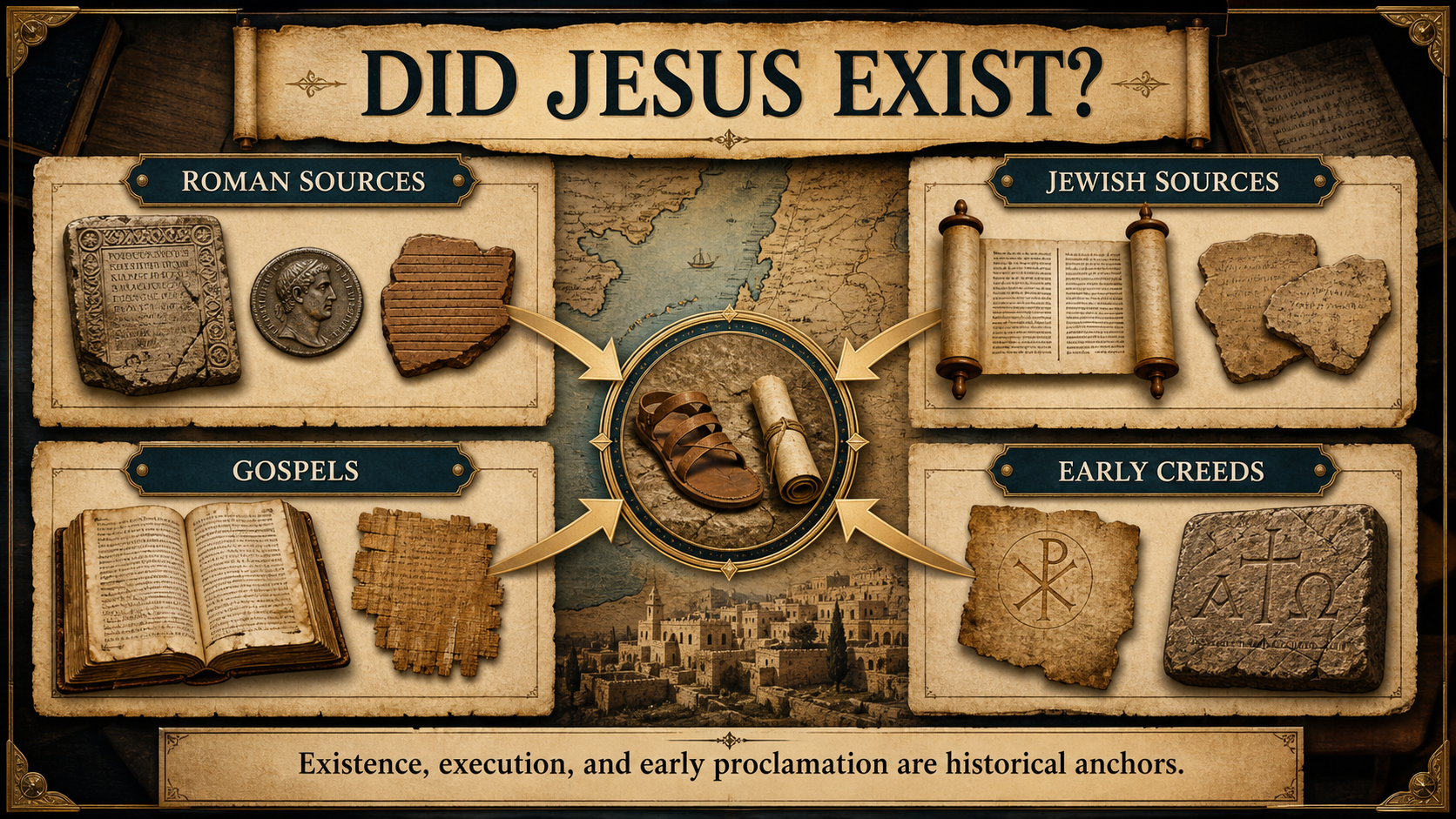
Where the evidence for Jesus comes fromFour kinds of evidence historians weigh when asking whether Jesus existed: Roman writers, Jewish writers, the Gospels, and the early creeds Paul quotes.Show the chart
Questions you might still have
Aren't the Gospels useless as evidence, since believers wrote them?
Having a point of view does not make a source useless. If it did, we would lose most of ancient history, since nearly every ancient writer had a cause. Historians read partisan sources critically, paying most attention to details the writer had no reason to invent. The Gospels contain several: a crucified Messiah, women as the first witnesses to the empty tomb at a time when women’s testimony carried little weight, and disciples who come across as slow and frightened. The existence question also does not depend on the Gospels. Paul’s letters and the Roman and Jewish writers are enough on their own.
Isn't the Josephus passage a known forgery?
Part of it was changed. Lines such as “he was the Christ” read like a Christian wrote them, and almost all scholars agree they were added by copyists. Edited is not the same as invented, though. The majority view is that Josephus wrote a shorter, neutral notice about Jesus that a later hand expanded. His second mention, which identifies James as the brother of Jesus, the one called Christ, has no sign of Christian editing and is widely accepted. Used carefully, Josephus shows that a Jewish historian of the first century knew Jesus as a real person with a brother and a following. That is all this page relies on him for.
If Jesus was so important, why don't more Roman records mention him?
The record is thin. Most of what Roman officials wrote has not survived. What we have comes from a small number of writers who cared mainly about emperors, wars, and the Roman elite. A Galilean teacher executed in a provincial capital would not have interested them. Romans began to mention Jesus when his followers became a visible problem in Rome itself, which is exactly the setting in which Tacitus writes about him. By the standards of the time, a Jewish peasant teacher with references in Paul, Josephus, and Tacitus is well attested.
If Jesus existed, does that make Christianity true?
No. Jesus’ existence and his crucifixion fit a world in which he was a real teacher and nothing more. Ehrman accepts both and does not believe Jesus rose from the dead. Once you grant that Jesus lived and was executed, the question becomes why his followers, within a few years, were announcing in Jerusalem that he had been raised, and why some of them suffered rather than stop saying it. That is a separate argument, and it deserves to be judged on its own evidence. The case for the crucifixion itself is set out in the crucifixion of Jesus.
Where this leaves us
The view that Jesus never existed starts from real observations: nothing from his lifetime mentions him, his followers wrote the Gospels, and one Josephus passage was edited. It does not follow that he was invented. Paul met his brother, Tacitus and Josephus treat him as a real man who was executed, and historians who reject Christianity, Ehrman among them, agree. None of that proves the resurrection or anything else Christians believe. It leaves a narrower and more interesting question: what happened after a real man was crucified under Pilate that led his followers to say he was alive?
Keep reading
Check the sources
This page relies on these sources. Each has its own page with the full citation and, where one exists, a link to the original.
- ScholarshipDid Jesus Exist?
- Primary sourceAnnals 15.44
- Primary sourceAntiquities of the Jews 18.63-64
- Primary sourceAntiquities of the Jews 20.200