What you may have heard
The Trinity is shirk
I believe God is one. He neither begets nor is born, and nothing is like Him. To speak of Father, Son, and Holy Spirit is to associate partners with God, which is shirk, and Christians worship a man beside Him.
What the evidence shows
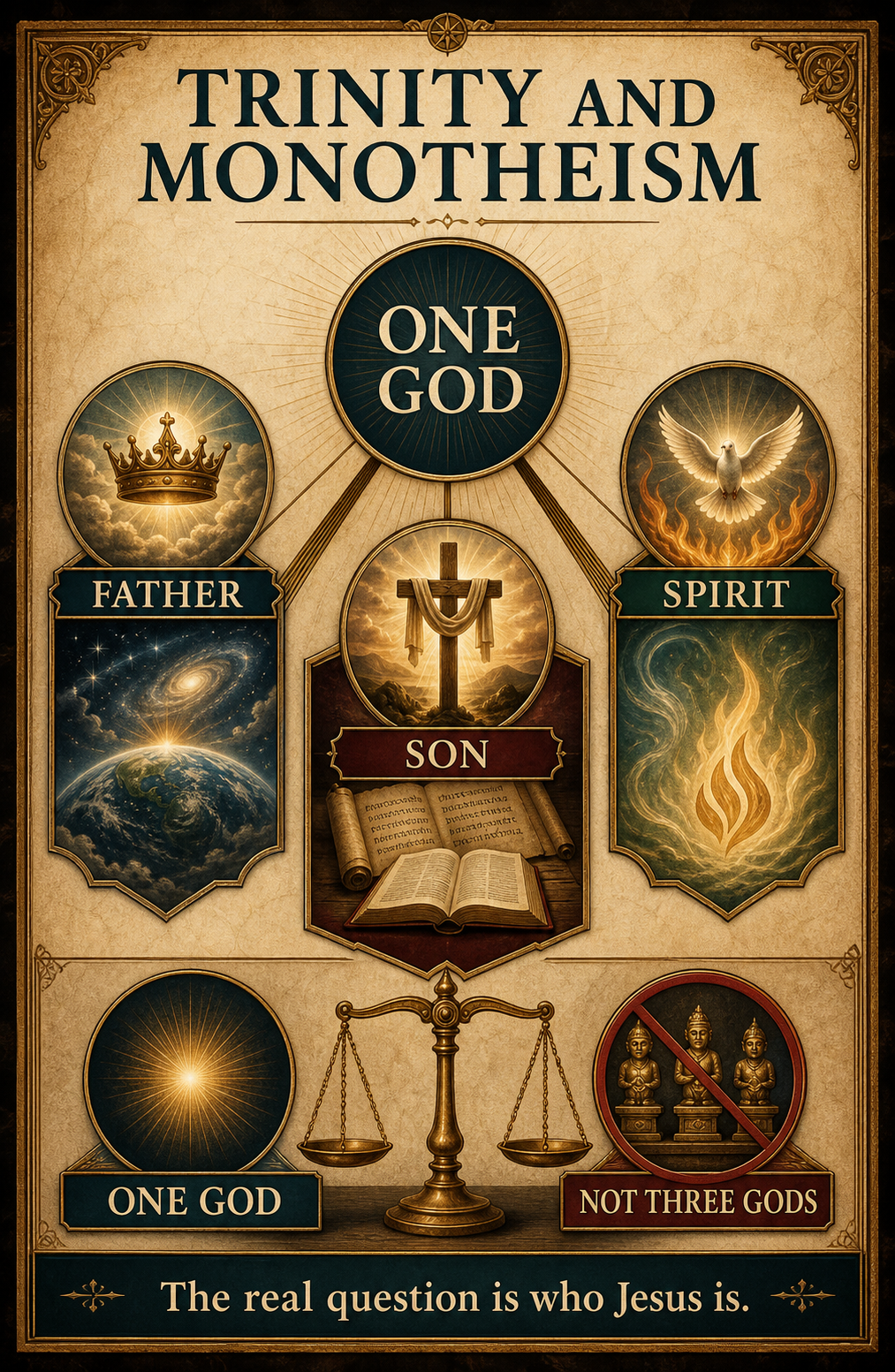
You are right that God is one and that nothing may be associated with him; Christians believe that too, and they also reject three gods and a God who took a consort. Your objection does not depend on those ideas: classical Muslim teaching rejects the Christian claim itself, that Jesus is God’s eternal Son, as a breach of God’s oneness. The real disagreement is whether the one God can exist eternally as Father, Son, and Spirit and still be one, and whether Jesus is that eternal Word. This page sets out why Christians answer yes to both, and leaves the judgment with you.
On this page
- Why it seems true
- Christians also say God is one, and reject several ideas the Qur'an condemns
- Christians mean an eternal Son, and Islam rejects that too
- The real question is what God's oneness rules out
- Jesus' first followers were strict monotheists who worshiped him
- Two questions remain
- Questions you might still have
- Where this leaves us
- Check the sources
Why it seems true
At the heart of Islam is tawhid, the oneness of God: God is one, undivided, and shares his divinity with no one. Its opposite is shirk, associating partners with God, and the Qur’an says, “Indeed, Allāh does not forgive association with Him” (4:48). It says of God, “He neither begets nor is born, nor is there to Him any equivalent” (112:3-4), and it tells Christians, “do not say, ‘Three’; desist” (4:171). Ibn Kathir, commenting on that verse, knew what the churches taught. He describes the council under Constantine and the churches that followed it, which “agreed that `Isa was divine,” and he rejects them all. An eternal, nonphysical Son is still a second who is called God and receives worship. However carefully it is explained, it is what tawhid excludes.
Much of this is true. Christians do worship Jesus and pray to him, and “Son” is their own word. They do confess that the Father is God, the Son is God, and the Spirit is God. The Qur’an’s phrase “third of three” (5:73) is close to the way Christians speak, and you are right to notice that. Christians have often explained the Trinity badly, with comparisons such as water, ice, and steam that mislead more than they help. And the concern behind your charge is one the Hebrew Bible shares. God says through Isaiah, “I am the LORD; that is My name! I will not yield My glory to another” (Isaiah 42:8). Your objection does not need Christians to believe in three gods. It needs only what they do confess, and whether that confession is compatible with God’s oneness is the question.
Christians also say God is one, and reject several ideas the Qur'an condemns
Christian faith begins with the same confession as Jewish faith: “Hear, O Israel: The LORD our God, the LORD is One” (Deuteronomy 6:4). When Jesus was asked which commandment was most important, he quoted those words (Mark 12:29). No Christian church teaches that there are three gods.
Some popular objections, and some readings of the Qur’an, target ideas that Christians reject as firmly as you do.
- The Qur’an pictures God asking Jesus, “did you say to the people, ‘Take me and my mother as deities besides Allāh?’” (5:116). Some early interpreters, reported by Ibn Kathir, read “third of three” (5:73) the same way. No mainstream church has ever taught that Mary is God or part of God.
- It asks how God could have a son “when He does not have a companion” (6:101). Christians agree that God has no consort and did not father a child in any physical way.
- Christians do not believe God is one member of a group of three gods.
Clearing this ground does not answer your objection. The Qur’an also says, “Exalted is He above having a son” (4:171), and Ibn Kathir’s commentary on that verse describes the councils and churches that confessed Jesus as divine and rejects them all, not only a crude picture of a divine family.
Claims Christians also reject, and what Christians confess
Setting aside what both faiths reject shows where the real disagreement lies.
Claims Christians also reject
Three gods. God taking a consort and fathering a son. Mary as a deity beside God. A creature worshiped beside the Creator.
The question it raises
Muslims and Christians reject each of these together.
What Christians confess
One God, who exists eternally as Father, Son, and Holy Spirit. The Son not made, and not born of a consort. The Son became a man in Jesus.
The question it raises
Can the one God be Father, Son, and Spirit and still be one? Is Jesus his eternal Word?
The disagreement is not about how many gods there are. It is about what God’s oneness allows, and who Jesus is.
Christians mean an eternal Son, and Islam rejects that too
Christians do not think of the Trinity as an addition: God, and then two others beside him. They believe there is one God, one divine being with one will and one nature, and that this one God exists eternally as three persons, the Father, the Son, and the Holy Spirit. “Person” here does not mean a separate being, as three human beings are three separate beings. It names a distinct relation within the one God. And by “Holy Spirit” Christians do not mean the angel Gabriel, as Muslims understand Ruh al-Qudus, but God’s own Spirit.
“Son” is the word that gives the most offense. The Nicene Creed, the fourth-century statement of faith that most churches still recite, says the Son is “begotten, not made.” Christians use “begotten” for an eternal relationship, not a physical birth: the Son is from the Father as a word is from the one who speaks it, with no mother and no beginning.
Islam rejects divine sonship in that sense too. Muslim scholars read “He neither begets nor is born” (112:3) as a denial that God has any son at all, and Ibn Kathir’s commentary on 4:171 discusses the council under Constantine where the creed was first written. So you can understand exactly what Christians mean and still judge that it breaks God’s oneness.
The real question is what God's oneness rules out
Shirk is associating partners with God: setting up anything as a rival, an equal, or a second god beside him, in his being, his rule, or his worship. Christians agree that this is the gravest wrong. Their claim is that the Son and the Spirit are not partners beside God, because they are not other beings. They are the one God’s own Word and Spirit, sharing his one being, not added to it.
You may reply that this is a distinction without a difference. Christians think the difference is real. A partner is someone outside God who shares what is God’s. Oneness rules that out completely. Whether oneness also rules out every distinction within God is a further question, and Muslim theology has faced a form of it. Sunni teaching holds that the Qur’an is God’s uncreated speech, eternal with him, and that this does not divide him. Muslim scholars distinguish an eternal attribute from a person. Christians are asking a related question: can God’s eternal Word be with him and be him without becoming a second god?
The Qur’an itself calls Jesus “His word which He directed to Mary and a soul [created at a command] from Him” (4:171). Ibn Kathir reads this as the creating word “Be,” and insists that “from Him” does not mean part of God. Christians read the same language as pointing to the eternal Word. That is where the two faiths part, and it comes down to who Jesus is.
Jesus' first followers were strict monotheists who worshiped him
The Trinity was not imported later by Greeks who were used to many gods. Jesus’ first followers were Jews who would have died rather than worship an idol.
Within twenty years of Jesus’ death, Paul, a former Pharisee, rewrote Israel’s confession of one God this way: “there is but one God, the Father, from whom all things came… and there is but one Lord, Jesus Christ, through whom all things came” (1 Corinthians 8:6). He did not add a second god. He placed Jesus inside the confession of the one God. The scholar Richard Bauckham, in Jesus and the God of Israel, calls this including Jesus in the unique identity of God.
John’s Gospel opens the same way: “In the beginning was the Word, and the Word was with God, and the Word was God… Through Him all things were made” (John 1:1). The one through whom all things were made is not one of the things made. Larry Hurtado’s Lord Jesus Christ traces how Jewish believers prayed to Jesus and sang to him from the earliest years, while still refusing every other god.
You do not need to accept these writings as Scripture to see what they show: the earliest Christians believed they were keeping the confession of one God, not leaving it. The doctrine of the Trinity, worked out over the following centuries, was the church’s attempt to say both things at once: God is one, and Jesus belongs within that one God.
Two questions remain
This page does not show that the Trinity is true, or that Christians have answered your objection. What it does show is narrower: the Trinity is not three gods, and Christians do not intend to set up a partner beside God. They believe they are worshiping the one God and no other.
Whether that belief holds depends on two questions that Islam and Christianity answer differently. The first is whether distinct persons within the one God are compatible with his oneness. The second is who Jesus is. If Jesus was a created messenger, the charge of shirk stands. If he is the Word through whom all things were made, Christians believe it does not. The second question can be examined from the earliest sources about him. The Christian case is set out in Jesus is God.
And do not say, "Three"; desist - it is better for you. Indeed, Allāh is but one God. Exalted is He above having a son.
These three sects agreed that `Isa was divine, but disputed regarding the manner in which `Isa's divinity was related to his humanity
O Jesus, Son of Mary, did you say to the people, "Take me and my mother as deities besides Allāh?"
At a glance
The Trinity and belief in one GodChristians confess one God who is Father, Son, and Holy Spirit, and reject the idea of three gods.Show the chart
Questions you might still have
Isn't "three in one" a contradiction?
It would be if Christians said God is one and three in the same sense: one God and three gods, or one person and three persons. They say God is one in being and three in persons. You may still find that hard to grasp, and Christians agree that God’s inner life is beyond full human understanding. The Qur’an also says, “There is nothing like unto Him” (42:11). Something can be beyond our full understanding without being a contradiction.
I know Christians don't mean a physical son. Why is it still not shirk?
You are right that the physical sense is not the issue. Islam rejects an eternal Son as well, and Ibn Kathir’s commentary on 4:171 rejects the churches that confessed one, not only a crude idea of God fathering a child. Christians answer that shirk is associating a partner with God, someone other than God who shares what is his. They believe the Son is not other than God but God’s own eternal Word, one in being with the Father. Whether that answer holds is the real disagreement, and it is fair for you to judge that it does not.
The word "Trinity" isn't in the Bible. Isn't it a later invention?
You are right that the word is not in the Bible. It first appears in Christian writings in the late second century. The word is a summary, though, not the evidence. The belief it summarizes, that there is one God and that Jesus and the Spirit belong within that one God, is found in the first-century writings themselves, such as Paul’s letters. A later word can name an earlier belief, much as tawhid is a term that Muslim scholars use to sum up what the Qur’an teaches about God’s oneness.
The Qur'an calls Jesus "a word from Him." Does that support the Christian view?
Christians have long noticed that the Qur’an calls Jesus “a word from Him” (3:45) and “His word which He directed to Mary and a soul [created at a command] from Him” (4:171). Muslim interpreters such as Ibn Kathir read this to mean that Jesus was created by God’s word “Be,” like Adam (3:59), and that “from Him” does not mean part of God. That reading should be respected, and the phrase alone does not settle the question. It does show that the Qur’an speaks of Jesus in a way it speaks of no other prophet, and it is fair to ask why.
Why not keep it simple and worship God without the Son?
Christians do believe they worship God alone. The question is who God has shown himself to be. Simplicity is not the test of truth; what God has revealed is. If God is in fact Father, Son, and Spirit, then a simpler picture would be less true, not more faithful. If he is not, the Trinity is wrong. Either way the answer comes from the evidence about Jesus and from what God’s oneness requires, not from which idea is easier to state.
Where this leaves us
The charge that the Trinity is shirk rests on a conviction Christians share: God is one, and nothing may be set beside him. Christians also reject three gods, a God with a consort, and Mary as a deity, but your objection does not rest on those. It rests on whether an eternal Son and Spirit within the one God can be reconciled with his oneness, and on who Jesus is. Christians believe they can, because the Son is God’s own Word and not a partner beside him. This page does not show that they are right. The charge stands or falls on those two questions, and the second can be examined from the earliest sources about Jesus.
Keep reading
- The Trinity is monotheismThe Bible says there is one God, distinguishes the Father, Son, and Spirit from one another, and treats each as that one God. The Trinity is the summary that keeps all three.
- Jesus is GodThe New Testament places Jesus inside the identity of Israel's one God, the Creator, while still distinguishing him from the Father.
- Biblical monotheismIsaiah denies that any god was formed before or after the LORD. That rules out a family of gods and gods who were once creatures, and it sets the test for every later claim.
- Jesus never claimed to be GodThe earliest records show Jesus claiming God's own authority, and his followers worshiping him within decades, long before the Council of Nicaea.
- The Trinity and incarnation violate monotheismChristians confess one God, not three. They claim Jesus belongs within the identity of Israel's one God, a claim argued from the Hebrew Bible, not polytheism.
- Jesus was a MuslimJesus submitted wholly to God, but the earliest records show a Jewish teacher who spoke of himself and his death in ways the Qur'an later denies.
Check the sources
This page relies on these sources. Each has its own page with the full citation and, where one exists, a link to the original.
- Official sourceThe Qur'an
- Reference workTafsir Ibn Kathir on Qur'an 4:171
- Reference workTafsir Ibn Kathir on Qur'an 5:73
- ScholarshipJesus and the God of Israel
- ScholarshipLord Jesus Christ